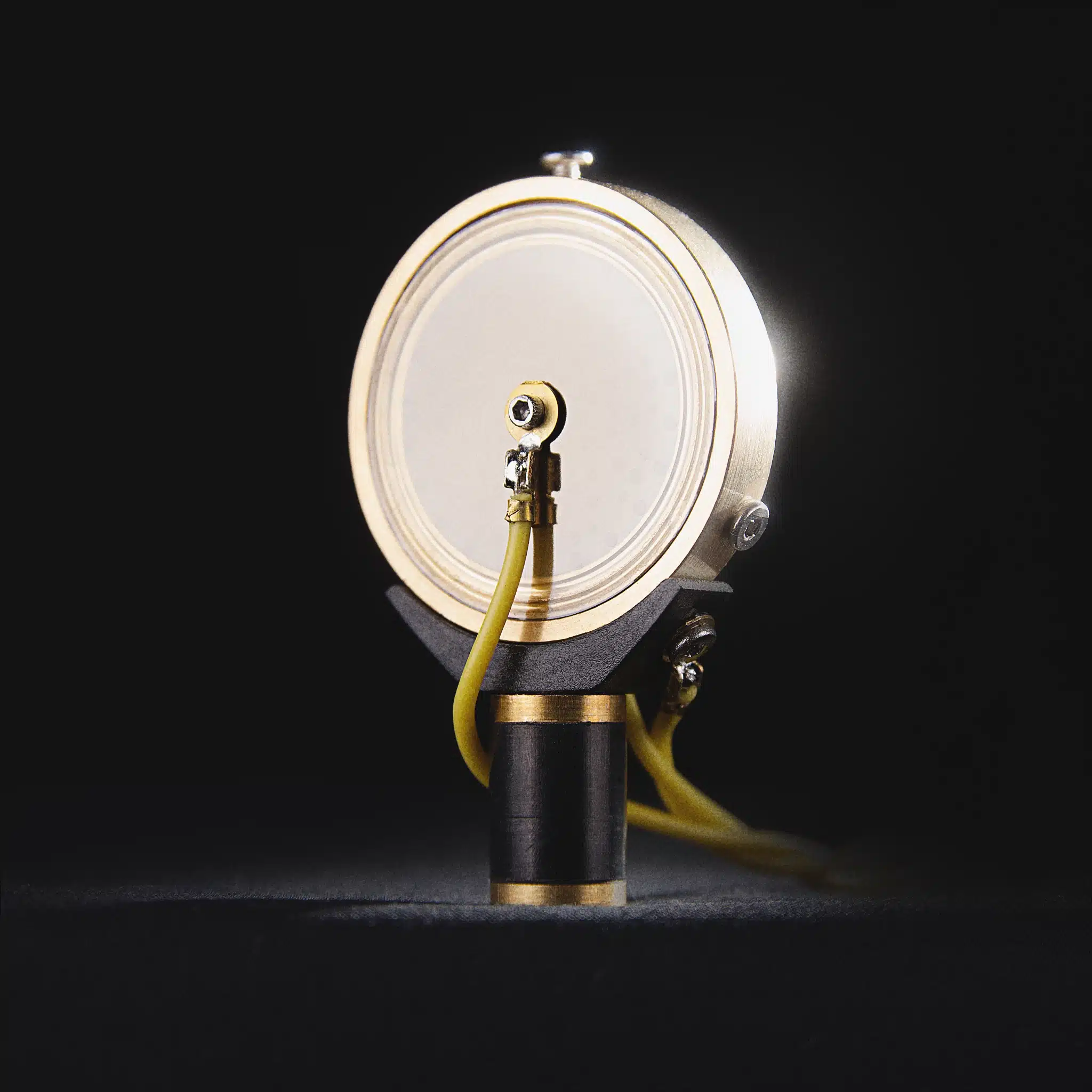
Arabella

(3 customer reviews)

The Beesneez Pro Audio Arabella is a large diaphragm tube condenser microphone that beautifully bridges the gap between classic character and modern versatility. Inspired by the revered sonic heritage of the great European valve microphones, Arabella delivers a smooth, harmonically rich tone with a forward presence that flatters both vocals and instruments.

At the heart of Arabella is the Beesneez K47 capsule, meticulously tuned to capture every nuance with stunning accuracy while retaining a lush, vintage-inspired warmth. Its valve circuitry adds depth and dimension, offering that unmistakable “larger-than-life” quality prized in world-class recordings.

From intimate vocal performances to grand instrumental arrangements, Arabella shines with detail, clarity, and musicality. Built entirely in-house by Beesneez in Australia, it exemplifies the brand’s commitment to artisanal craftsmanship, uncompromising quality, and microphones that are designed to inspire.

Key Features

  • Precision crafted large diaphragm condenser capsule for authentic vintage tone.
  • Valve circuit design for warmth, richness, and harmonic depth.
  • Forward presence that enhances vocals and solo instruments.
  • Ideal for vocals, acoustic instruments, and full-range studio application.
  • Precision-built in Australia with the Beesneez renowned craftsmanship.

What is in the box:

Why should I choose the Beesneez Pro Audio Arabella?

If you want a microphone that inspires performances, delivers world-class results across a variety of sources, and becomes a true centrepiece in your studio, the Beesneez Arabella is a microphone you’ll reach for again and again. The Arabella doesn’t just emulate classic microphones like the Neumann U47/U49 — it intentionally blends their sonic elegance with modern flexibility and uncompromising build quality. Every element, from the Beesneez K47 capsule to its toroidal transformer and premium electronic components—the Arabella has been designed to reflecting the Beesneez artisanal ethos and engineering precision.

Want to know more about the microphone that inspired the Arabella, read our Learning Center article: What Is the History of the Neumann U47 Microphone

Interested to know more about the history of the K47 capsule, read our article: What Makes the Neumann K47 Capsule Iconic?

Listen to the Arabella

Female Vocals

Abbie-Arabella-Solo

Recording artist: Abbie Cardwell

Abbie-Arabella-Mix

Recording artist: Abbie Cardwell

Male Vocals

Nino-Arabella-Mix

Recording artist: Nino Haggith

Specifications for the BeesNeez Arabella Tube Condenser Microphone

Specification Details
Type Large-diaphragm Tube Condenser Microphone
Capsule BeesNeez K47 Capsule
Polar patterns Nine switchable patterns — omni, cardioid and figure-eight
Frequency response 20 Hz–17 kHz
Impedance 150 Ω
Maximum SPL 125 dB
Tube Russian 6ZH8
Transformer 6.5:1 toroidal transformer with a Ni78 permalloy core
Power requirement 115–230 V — suitable for mains supplies from 100 V to 240 V

AUD $3,720.00

Free Delivery


Frequently Asked Questions

The BeesNeez Arabella and the vintage Neumann U 47 share an important part of their sonic heritage, but they are not identical microphones. The Arabella is designed to capture the character and musical qualities associated with classic European valve microphones while incorporating modern components, construction, and greater versatility.

The vintage U 47 was introduced by Neumann in 1949 and used the M7 dual-diaphragm capsule, later transitioning to the K47 toward the end of the 1950s. It used the legendary VF 14 tube and BV 08 transformer and provided two polar patterns: cardioid and omnidirectional. Neumann emphasizes that the sound of the original U 47 comes from the interaction of all of these components rather than from the capsule alone. Neumann U 47 historical information.

The Arabella takes a different approach. It uses the BeesNeez K47 capsule together with a Russian 6ZH8 tube and a BeesNeez 6.5:1 toroidal transformer with a Ni78 permalloy core. It also provides nine selectable polar patterns, giving the microphone considerably more flexibility than the original U 47. ([beesneezproaudio.com](https://beesneezproaudio.com/product/arabella/))

In practical terms, the differences can be summarized as follows:

  • Capsule: The vintage U 47 used the M7 and later K47; the Arabella uses the BeesNeez K47.
  • Tube: The original U 47 used the highly specialized VF 14 tube; the Arabella uses a Russian 6ZH8 tube.
  • Transformer: The vintage U 47 used the Neumann BV 08 transformer; the Arabella uses a BeesNeez 6.5:1 toroidal transformer with a Ni78 permalloy core.
  • Polar patterns: The U 47 provides cardioid and omni; the Arabella provides nine selectable patterns, including omni, cardioid, figure-8, and intermediate patterns.
  • Construction: The vintage U 47 was manufactured in Germany using components and manufacturing techniques specific to its period; the Arabella is built in Australia using modern components and BeesNeez manufacturing techniques.

Sonically, the Arabella is intended to sit in the same general family as classic U 47-style microphones, with a smooth, harmonically rich tone, strong presence, and a larger-than-life quality. However, it should not be represented as an exact replica of any particular vintage U 47. Vintage U 47 microphones themselves can vary considerably depending on their production era, capsule, tube, transformer, component condition, and subsequent servicing.

One particularly important consideration is the capsule. Neumann states that the later K47 was a re-engineered version of the M7 with essentially the same capsule acoustics, but with a more durable polyester diaphragm replacing the older PVC diaphragm. The Arabella uses a BeesNeez K47, giving it a modern, stable capsule platform while retaining the K47 approach to the U 47 sound. Neumann's U 47 history.

The Arabella also offers considerably more flexibility than a vintage U 47. With nine selectable polar patterns, it can be used as an omni, cardioid, figure-8, or one of several intermediate patterns. This makes it useful for a wider range of recording techniques than the original U 47. ([beesneezproaudio.com](https://beesneezproaudio.com/product/arabella/))

For a vocalist or engineer looking specifically for the unique experience of recording through an original vintage U 47, there is no substitute for the original microphone. However, for someone looking for a modern, reliable tube microphone with a K47-inspired sonic character and substantially greater pattern flexibility, the Arabella offers a different and highly versatile interpretation of the classic European tube microphone sound.

In short, the Arabella should not be viewed as simply a copy of a vintage U 47. It is better understood as a modern BeesNeez interpretation of the classic U 47/U 49 family of microphones, combining the character of a K47 capsule and valve circuit with modern components, Australian construction, and nine-pattern versatility.

The BeesNeez Arabella and the vintage Neumann M 49 share a particularly close connection. Both are large-diaphragm valve microphones designed around the classic German microphone tradition, and both are capable of producing a rich, smooth, highly detailed sound. However, the Arabella is not intended to be an exact replica of the M 49. Instead, it combines elements of the classic M 49/U 47 family with modern components and a much greater degree of flexibility.

The Neumann M 49 was introduced in 1951 and was developed in cooperation with the Northwest German Broadcasting Corporation (NWDR). One of its defining innovations was the ability to continuously vary the polar pattern remotely from the power supply, allowing the microphone to move smoothly from omnidirectional through cardioid to figure-8. Neumann describes the M 49 as a universal studio microphone, suitable for vocals, piano, orchestra, brass, and many other recording applications. Neumann M 49 history. :contentReference[oaicite:0]{index=0}

The Arabella takes inspiration from this same family of microphones but uses modern BeesNeez components and construction. It incorporates a BeesNeez K47 capsule, a Russian 6ZH8 tube, and a BeesNeez 6.5:1 toroidal transformer with a Ni78 permalloy core. It also provides nine selectable polar patterns, including omni, cardioid, figure-8, and intermediate patterns.

In practical terms, the differences can be summarized as follows:

  • Capsule: Early M 49 microphones used the M7 capsule, while later microphones transitioned to the K49. Neumann states that the M7 and K49 are acoustically very similar, another name for the designated K49 capsule is the K47. The Arabella uses a BeesNeez K47 capsule.
  • Tube: Early M 49 microphones used the Hiller MSC2, followed by the Telefunken AC701 and AC701k. The Arabella uses a Russian 6ZH8 tube.
  • Polar patterns: The M 49 provides continuously variable patterns from omni through cardioid to figure-8. The Arabella provides nine selectable patterns covering the same fundamental range, including intermediate patterns.
  • Pattern control: The original M 49's pattern was remotely controlled from its power supply. The Arabella provides selectable patterns through its modern power-supply/control system.
  • Transformer: The original M 49 uses the Neumann BV11 transformer in later revisions, while the Arabella uses a BeesNeez 6.5:1 toroidal transformer with a Ni78 permalloy core.
  • Construction: The M 49 was manufactured in Germany using period-specific components and construction methods. The Arabella is manufactured in Australia using modern components and BeesNeez design and construction techniques.

The capsule history is particularly interesting. The original M 49 used the M7 capsule, and around 1958 Neumann changed to the K49. According to Neumann, the two capsules were acoustically almost identical, while the K49 offered improved manufacturing consistency and a more durable diaphragm material. :contentReference[oaicite:1]{index=1}

There is also an important difference in the polar-pattern system. The original M 49 was revolutionary because its pattern could be continuously adjusted from the power supply. The Arabella provides nine selectable patterns rather than continuously variable control. This means the Arabella offers substantial pattern flexibility, but it does not reproduce the original M 49's continuously variable pattern system. :contentReference[oaicite:2]{index=2}

Sonically, the M 49 is famous for its full, silky, balanced sound. Neumann describes the M 49 as having a balanced frequency response across its directional patterns and a character that has made it particularly successful on vocals as well as a wide range of instruments. :contentReference[oaicite:3]{index=3}

The Arabella is designed to provide a similarly rich, smooth, musical tube-microphone character, while offering the reliability of modern components and considerably more flexibility than a vintage microphone. As with any comparison between a modern microphone and a vintage classic, it would be misleading to suggest that every vintage M 49 will sound identical to every Arabella—or even that every vintage M 49 sounds identical to another M 49. Original M 49 microphones went through several revisions between 1951 and 1971, including changes to the tube, transformer, capsule, and circuitry. :contentReference[oaicite:4]{index=4}

For someone specifically seeking the historical M 49 experience, a well-preserved vintage M 49 remains a unique microphone. For someone looking for a modern microphone that draws on the same classic German tube-microphone heritage, the Arabella offers a different approach: a K47 capsule, valve circuitry, modern transformer technology, Australian construction, and nine selectable polar patterns.

In short, the Arabella should not be viewed simply as a copy of the M 49. It is better understood as a modern BeesNeez interpretation of the classic M 47/M 49/U 47 family, designed to deliver the musical qualities associated with these legendary microphones while providing modern reliability, serviceability, and versatility.

The BeesNeez Arabella features nine selectable polar patterns, giving you considerably more flexibility than a microphone limited to a single pattern or just the three traditional settings.

The three primary patterns are:

  • Omnidirectional — captures sound from all directions and can provide a natural, open sound with excellent room ambience.
  • Cardioid — focuses primarily on sound from the front of the microphone while rejecting sound from the rear. This is an excellent general-purpose setting for vocals and many instruments.
  • Figure-8 — captures sound from the front and rear while rejecting sound from the sides. This can be particularly useful for room recording, vocal duets, and stereo recording techniques.

In addition to these three primary patterns, the Arabella provides six intermediate patterns between Omni, Cardioid, and Figure-8. This allows you to fine-tune the microphone's directional response to suit the recording environment and sound source.

The nine available patterns provide a useful range of options:

  • Omni
  • Wide cardioid
  • Cardioid
  • Intermediate cardioid/figure-8 patterns
  • Figure-8

The intermediate settings can be particularly useful when the standard Omni, Cardioid, or Figure-8 patterns aren't quite right for a particular recording. For example, a wider cardioid pattern can provide more room ambience while still offering some rejection from behind the microphone, while a tighter pattern can provide greater focus on the sound source.

This flexibility makes the Arabella a highly versatile studio microphone. You can use Cardioid for a focused vocal recording, Omni when you want a more natural and spacious sound, or Figure-8 for techniques such as recording two sound sources from opposite sides of the microphone.

Because the Arabella uses a BeesNeez K47 dual-diaphragm capsule, the microphone is able to provide this range of polar patterns by varying the polarization of the capsule's front and rear diaphragms. The result is a microphone that can be adapted to a wide range of recording situations rather than being limited to one particular pickup pattern.

In short, the Arabella provides nine switchable polar patterns covering the range from Omni through Cardioid to Figure-8, making it an exceptionally flexible microphone for vocals, acoustic instruments, drums, guitar cabinets, room recording, and many other studio applications.

Arabella

(3 customer reviews)

The Beesneez Pro Audio Arabella is a large diaphragm tube condenser microphone that beautifully bridges the gap between classic character and modern versatility. Inspired by the revered sonic heritage of the great European valve microphones, Arabella delivers a smooth, harmonically rich tone with a forward presence that flatters both vocals and instruments.

At the heart of Arabella is the Beesneez K47 capsule, meticulously tuned to capture every nuance with stunning accuracy while retaining a lush, vintage-inspired warmth. Its valve circuitry adds depth and dimension, offering that unmistakable “larger-than-life” quality prized in world-class recordings.

From intimate vocal performances to grand instrumental arrangements, Arabella shines with detail, clarity, and musicality. Built entirely in-house by Beesneez in Australia, it exemplifies the brand’s commitment to artisanal craftsmanship, uncompromising quality, and microphones that are designed to inspire.

Key Features

  • Precision crafted large diaphragm condenser capsule for authentic vintage tone.
  • Valve circuit design for warmth, richness, and harmonic depth.
  • Forward presence that enhances vocals and solo instruments.
  • Ideal for vocals, acoustic instruments, and full-range studio application.
  • Precision-built in Australia with the Beesneez renowned craftsmanship.

What is in the box:

Why should I choose the Beesneez Pro Audio Arabella?

If you want a microphone that inspires performances, delivers world-class results across a variety of sources, and becomes a true centrepiece in your studio, the Beesneez Arabella is a microphone you’ll reach for again and again. The Arabella doesn’t just emulate classic microphones like the Neumann U47/U49 — it intentionally blends their sonic elegance with modern flexibility and uncompromising build quality. Every element, from the Beesneez K47 capsule to its toroidal transformer and premium electronic components—the Arabella has been designed to reflecting the Beesneez artisanal ethos and engineering precision.

Want to know more about the microphone that inspired the Arabella, read our Learning Center article: What Is the History of the Neumann U47 Microphone

Interested to know more about the history of the K47 capsule, read our article: What Makes the Neumann K47 Capsule Iconic?

Listen to the Arabella

Female Vocals

Abbie-Arabella-Solo

Recording artist: Abbie Cardwell

Abbie-Arabella-Mix

Recording artist: Abbie Cardwell

Male Vocals

Nino-Arabella-Mix

Recording artist: Nino Haggith

Specifications for the BeesNeez Arabella Tube Condenser Microphone

Specification Details
Type Large-diaphragm Tube Condenser Microphone
Capsule BeesNeez K47 Capsule
Polar patterns Nine switchable patterns — omni, cardioid and figure-eight
Frequency response 20 Hz–17 kHz
Impedance 150 Ω
Maximum SPL 125 dB
Tube Russian 6ZH8
Transformer 6.5:1 toroidal transformer with a Ni78 permalloy core
Power requirement 115–230 V — suitable for mains supplies from 100 V to 240 V

AUD $3,720.00

Free Delivery

Frequently Asked Questions

The BeesNeez Arabella and the vintage Neumann U 47 share an important part of their sonic heritage, but they are not identical microphones. The Arabella is designed to capture the character and musical qualities associated with classic European valve microphones while incorporating modern components, construction, and greater versatility.

The vintage U 47 was introduced by Neumann in 1949 and used the M7 dual-diaphragm capsule, later transitioning to the K47 toward the end of the 1950s. It used the legendary VF 14 tube and BV 08 transformer and provided two polar patterns: cardioid and omnidirectional. Neumann emphasizes that the sound of the original U 47 comes from the interaction of all of these components rather than from the capsule alone. Neumann U 47 historical information.

The Arabella takes a different approach. It uses the BeesNeez K47 capsule together with a Russian 6ZH8 tube and a BeesNeez 6.5:1 toroidal transformer with a Ni78 permalloy core. It also provides nine selectable polar patterns, giving the microphone considerably more flexibility than the original U 47. ([beesneezproaudio.com](https://beesneezproaudio.com/product/arabella/))

In practical terms, the differences can be summarized as follows:

  • Capsule: The vintage U 47 used the M7 and later K47; the Arabella uses the BeesNeez K47.
  • Tube: The original U 47 used the highly specialized VF 14 tube; the Arabella uses a Russian 6ZH8 tube.
  • Transformer: The vintage U 47 used the Neumann BV 08 transformer; the Arabella uses a BeesNeez 6.5:1 toroidal transformer with a Ni78 permalloy core.
  • Polar patterns: The U 47 provides cardioid and omni; the Arabella provides nine selectable patterns, including omni, cardioid, figure-8, and intermediate patterns.
  • Construction: The vintage U 47 was manufactured in Germany using components and manufacturing techniques specific to its period; the Arabella is built in Australia using modern components and BeesNeez manufacturing techniques.

Sonically, the Arabella is intended to sit in the same general family as classic U 47-style microphones, with a smooth, harmonically rich tone, strong presence, and a larger-than-life quality. However, it should not be represented as an exact replica of any particular vintage U 47. Vintage U 47 microphones themselves can vary considerably depending on their production era, capsule, tube, transformer, component condition, and subsequent servicing.

One particularly important consideration is the capsule. Neumann states that the later K47 was a re-engineered version of the M7 with essentially the same capsule acoustics, but with a more durable polyester diaphragm replacing the older PVC diaphragm. The Arabella uses a BeesNeez K47, giving it a modern, stable capsule platform while retaining the K47 approach to the U 47 sound. Neumann's U 47 history.

The Arabella also offers considerably more flexibility than a vintage U 47. With nine selectable polar patterns, it can be used as an omni, cardioid, figure-8, or one of several intermediate patterns. This makes it useful for a wider range of recording techniques than the original U 47. ([beesneezproaudio.com](https://beesneezproaudio.com/product/arabella/))

For a vocalist or engineer looking specifically for the unique experience of recording through an original vintage U 47, there is no substitute for the original microphone. However, for someone looking for a modern, reliable tube microphone with a K47-inspired sonic character and substantially greater pattern flexibility, the Arabella offers a different and highly versatile interpretation of the classic European tube microphone sound.

In short, the Arabella should not be viewed as simply a copy of a vintage U 47. It is better understood as a modern BeesNeez interpretation of the classic U 47/U 49 family of microphones, combining the character of a K47 capsule and valve circuit with modern components, Australian construction, and nine-pattern versatility.

The BeesNeez Arabella and the vintage Neumann M 49 share a particularly close connection. Both are large-diaphragm valve microphones designed around the classic German microphone tradition, and both are capable of producing a rich, smooth, highly detailed sound. However, the Arabella is not intended to be an exact replica of the M 49. Instead, it combines elements of the classic M 49/U 47 family with modern components and a much greater degree of flexibility.

The Neumann M 49 was introduced in 1951 and was developed in cooperation with the Northwest German Broadcasting Corporation (NWDR). One of its defining innovations was the ability to continuously vary the polar pattern remotely from the power supply, allowing the microphone to move smoothly from omnidirectional through cardioid to figure-8. Neumann describes the M 49 as a universal studio microphone, suitable for vocals, piano, orchestra, brass, and many other recording applications. Neumann M 49 history. :contentReference[oaicite:0]{index=0}

The Arabella takes inspiration from this same family of microphones but uses modern BeesNeez components and construction. It incorporates a BeesNeez K47 capsule, a Russian 6ZH8 tube, and a BeesNeez 6.5:1 toroidal transformer with a Ni78 permalloy core. It also provides nine selectable polar patterns, including omni, cardioid, figure-8, and intermediate patterns.

In practical terms, the differences can be summarized as follows:

  • Capsule: Early M 49 microphones used the M7 capsule, while later microphones transitioned to the K49. Neumann states that the M7 and K49 are acoustically very similar, another name for the designated K49 capsule is the K47. The Arabella uses a BeesNeez K47 capsule.
  • Tube: Early M 49 microphones used the Hiller MSC2, followed by the Telefunken AC701 and AC701k. The Arabella uses a Russian 6ZH8 tube.
  • Polar patterns: The M 49 provides continuously variable patterns from omni through cardioid to figure-8. The Arabella provides nine selectable patterns covering the same fundamental range, including intermediate patterns.
  • Pattern control: The original M 49's pattern was remotely controlled from its power supply. The Arabella provides selectable patterns through its modern power-supply/control system.
  • Transformer: The original M 49 uses the Neumann BV11 transformer in later revisions, while the Arabella uses a BeesNeez 6.5:1 toroidal transformer with a Ni78 permalloy core.
  • Construction: The M 49 was manufactured in Germany using period-specific components and construction methods. The Arabella is manufactured in Australia using modern components and BeesNeez design and construction techniques.

The capsule history is particularly interesting. The original M 49 used the M7 capsule, and around 1958 Neumann changed to the K49. According to Neumann, the two capsules were acoustically almost identical, while the K49 offered improved manufacturing consistency and a more durable diaphragm material. :contentReference[oaicite:1]{index=1}

There is also an important difference in the polar-pattern system. The original M 49 was revolutionary because its pattern could be continuously adjusted from the power supply. The Arabella provides nine selectable patterns rather than continuously variable control. This means the Arabella offers substantial pattern flexibility, but it does not reproduce the original M 49's continuously variable pattern system. :contentReference[oaicite:2]{index=2}

Sonically, the M 49 is famous for its full, silky, balanced sound. Neumann describes the M 49 as having a balanced frequency response across its directional patterns and a character that has made it particularly successful on vocals as well as a wide range of instruments. :contentReference[oaicite:3]{index=3}

The Arabella is designed to provide a similarly rich, smooth, musical tube-microphone character, while offering the reliability of modern components and considerably more flexibility than a vintage microphone. As with any comparison between a modern microphone and a vintage classic, it would be misleading to suggest that every vintage M 49 will sound identical to every Arabella—or even that every vintage M 49 sounds identical to another M 49. Original M 49 microphones went through several revisions between 1951 and 1971, including changes to the tube, transformer, capsule, and circuitry. :contentReference[oaicite:4]{index=4}

For someone specifically seeking the historical M 49 experience, a well-preserved vintage M 49 remains a unique microphone. For someone looking for a modern microphone that draws on the same classic German tube-microphone heritage, the Arabella offers a different approach: a K47 capsule, valve circuitry, modern transformer technology, Australian construction, and nine selectable polar patterns.

In short, the Arabella should not be viewed simply as a copy of the M 49. It is better understood as a modern BeesNeez interpretation of the classic M 47/M 49/U 47 family, designed to deliver the musical qualities associated with these legendary microphones while providing modern reliability, serviceability, and versatility.

The BeesNeez Arabella features nine selectable polar patterns, giving you considerably more flexibility than a microphone limited to a single pattern or just the three traditional settings.

The three primary patterns are:

  • Omnidirectional — captures sound from all directions and can provide a natural, open sound with excellent room ambience.
  • Cardioid — focuses primarily on sound from the front of the microphone while rejecting sound from the rear. This is an excellent general-purpose setting for vocals and many instruments.
  • Figure-8 — captures sound from the front and rear while rejecting sound from the sides. This can be particularly useful for room recording, vocal duets, and stereo recording techniques.

In addition to these three primary patterns, the Arabella provides six intermediate patterns between Omni, Cardioid, and Figure-8. This allows you to fine-tune the microphone's directional response to suit the recording environment and sound source.

The nine available patterns provide a useful range of options:

  • Omni
  • Wide cardioid
  • Cardioid
  • Intermediate cardioid/figure-8 patterns
  • Figure-8

The intermediate settings can be particularly useful when the standard Omni, Cardioid, or Figure-8 patterns aren't quite right for a particular recording. For example, a wider cardioid pattern can provide more room ambience while still offering some rejection from behind the microphone, while a tighter pattern can provide greater focus on the sound source.

This flexibility makes the Arabella a highly versatile studio microphone. You can use Cardioid for a focused vocal recording, Omni when you want a more natural and spacious sound, or Figure-8 for techniques such as recording two sound sources from opposite sides of the microphone.

Because the Arabella uses a BeesNeez K47 dual-diaphragm capsule, the microphone is able to provide this range of polar patterns by varying the polarization of the capsule's front and rear diaphragms. The result is a microphone that can be adapted to a wide range of recording situations rather than being limited to one particular pickup pattern.

In short, the Arabella provides nine switchable polar patterns covering the range from Omni through Cardioid to Figure-8, making it an exceptionally flexible microphone for vocals, acoustic instruments, drums, guitar cabinets, room recording, and many other studio applications.


Samples

—

3 reviews for Arabella

  1. Jon Chinn –

    Amazing flagship LDC for my collection as an alternate/compliment to the usual FET suspects. Beautiful highs, present lows and mids – no EQ needed to land in the mix. Glad to find the perfect balance of U47-inspirarion with the detail, tone and performance for modern music demands. Thank you!

  2. Chris –

    I used one of these extensively from 2009-2012 and I think I would go as far as saying it is my favourite condenser mic of all time.
    3 ft from the Drums, close on cabs, making vocals sound how you hear them in your head, this microphone is an all rounder in the true sense of the word. Really hard to make this thing sound bad.
    I also owned a pair of Judas and they were incredible for drum overheads.

  3. Sam Steensen –

    Love this mic for vocals
    Thank you so much beesneez

Add a review

Your email address will not be published. Required fields are marked *

This site uses Akismet to reduce spam. Learn how your comment data is processed.

Related Learning Centre Articles

Related Products